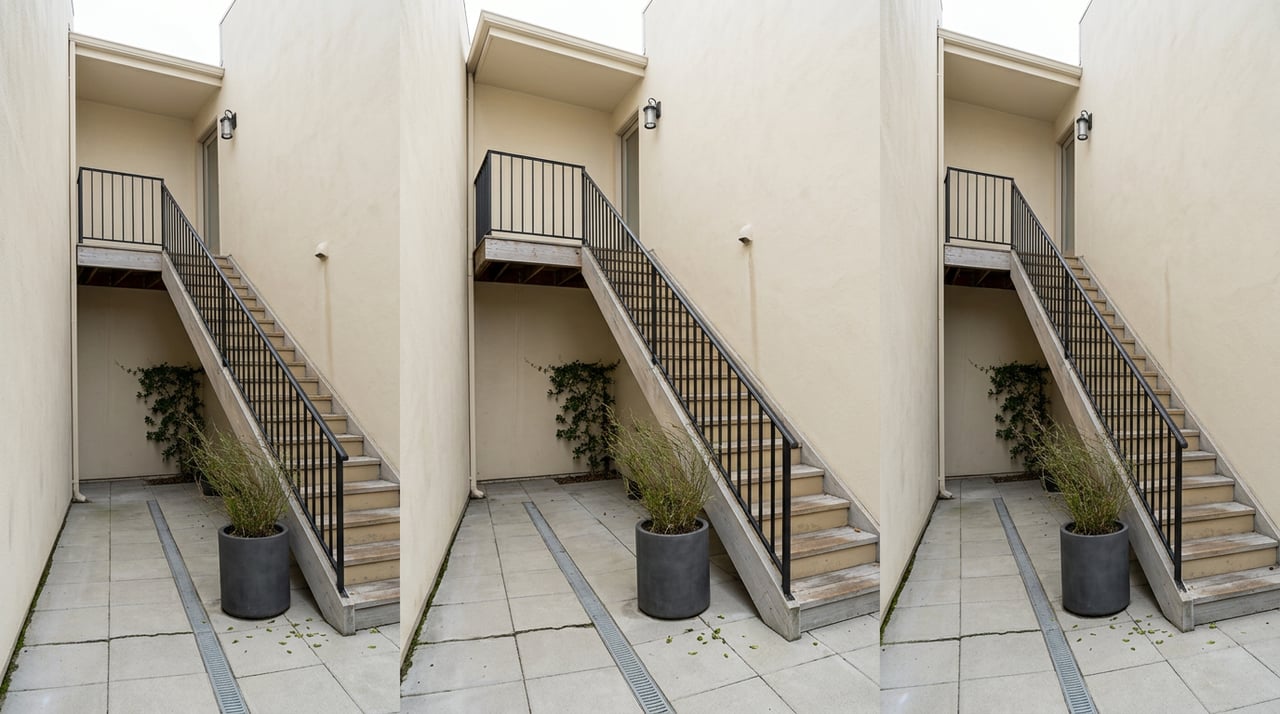
A buyer makes an offer on a three-unit building near Chestnut Street. The seller's disclosure package includes a clean seismic retrofit history. The buyer's agent confirms it against the city's own building records. Everyone exhales. Then, two weeks before closing, the lender comes back with a hold: the building has no record of a balcony inspection required under a different law entirely, one that has nothing to do with soft-story retrofits, and the loan can't move until that gap gets resolved.
This is happening across the Marina more often than most buyers expect, and it's not because sellers are hiding anything. It's because the neighborhood's paperwork changed shape this year, and the document everyone learned to ask for isn't the one that matters most anymore.
The Retrofit Question Everyone Already Asks
If you've spent any time looking at Marina condos, you already know the neighborhood's backstory. The district sits on fill land, built up from rubble after the 1906 earthquake to create ground for the 1915 Panama-Pacific International Exposition. That fill liquefied during the 1989 Loma Prieta earthquake, and the wood-frame buildings with open ground-floor garages here took the brunt of it. San Francisco's Mandatory Seismic Retrofit Program, Ordinance No. 66-13, exists largely because of what happened in the Marina that year. It targeted wood-frame buildings three stories or taller, or two stories over a garage, with five or more units, built before 1978.
That program has run its course. Compliance deadlines for every tier have now passed, and the city's Department of Building Inspection enforces violations under the standard building code rather than a rolling deadline schedule. You can still and should confirm a specific building's status on the city's own soft-story properties map, but for most Marina buyers this question is a formality now. The ordinance did its work. This is settled paperwork.
Which is exactly why it's the wrong place to stop.
The Building Type the Old Law Never Touched
The soft-story ordinance only ever applied to buildings with five or more units. Walk two blocks in almost any direction from Union Street and you'll pass Marina flats that were converted into three- and four-unit condominium buildings decades ago, the kind of small, wood-frame stock the neighborhood is full of. Those buildings were never on the retrofit list. They didn't need to be. The ordinance wasn't written for them.
A separate law was. California's SB 326, codified at Civil Code section 5551, requires condominium associations with three or more units to inspect exterior elevated elements, meaning the balconies, decks, stairways, and walkways that extend beyond a building's exterior walls and sit more than six feet above the ground. The law was written in response to a 2015 balcony collapse in Berkeley that killed six people, and it draws its unit threshold two notches lower than the seismic ordinance. A building too small to ever appear on the soft-story list can still be squarely inside the balcony law's reach.
| SF Soft-Story Ordinance (66-13) | SB 326 Balcony Law (Civil Code 5551) | |
|---|---|---|
| Minimum units covered | 5 or more | 3 or more |
| What it targets | Weak ground-floor framing | Balconies, decks, stairways, walkways |
| First deadline | Passed years ago, all tiers | January 1, 2025, passed |
| Status for Marina buyers | Largely closed | Actively surfacing findings |
The two laws were built for different failure modes and they don't overlap the way most buyers assume. A building can pass one and never have been subject to the other at all.
What Changed on January 1, 2026
Until this year, a diligent buyer's agent had to know to specifically request a building's SB 326 inspection report. It wasn't automatically part of the standard seller disclosure. That changed under SB 410, which amended the Davis-Stirling Act to fold the most recent SB 326 exterior elevated elements report directly into the Civil Code section 4525 disclosure packet, the same bundle that already includes a building's CC&Rs, budget, and reserve study. As of January 1, 2026, if a Marina condo qualifies under SB 326, its balcony inspection status is no longer optional information you have to dig for. It's baked into the file the seller is legally required to hand over.
That sounds like a paperwork footnote. It isn't. Lenders underwriting conventional loans increasingly treat an incomplete or unfavorable SB 326 report as a warrantability problem, the kind that can push a building outside Fannie Mae and Freddie Mac guidelines and shrink the buyer pool to cash offers only. Insurance carriers are asking the same question during underwriting.
The soft-story check tells you whether a Marina building survived its earthquake homework. The balcony report tells you whether it's still doing its homework right now.
What the Numbers Look Like When a Report Comes Back Bad
Inspections under SB 326 use a statistically significant sampling method, not a spot check of one or two units, and across California the findings have not been reassuring. Individual balcony repairs are running $10,000 to $25,000 depending on scope, and full reconstruction in expensive markets can reach $40,000 to $60,000 per unit. In the worst cases, where waterproofing failures reach the structural framing, special assessments have climbed as high as $175,000 per unit.
Not every finding is that severe, and a board can absorb a modest repair bill through its existing reserve fund without much drama. But it's worth knowing that under California Civil Code section 5605(b), an HOA board can levy a special assessment up to 5 percent of the association's annual budget without a membership vote. On a building with a $500,000 operating budget, that's $25,000 the board can assess unilaterally, which means a buyer shouldn't assume every repair bill will show up as a headline vote in the board minutes. Some of it moves quietly.
This is also where a reserve study earns its place in your reading pile. It's supposed to show the association's percent-funded ratio, meaning how much of the projected future repair cost is actually saved versus how much is aspirational. Industry guidance generally treats anything below 50 percent as a flag and 70 percent or higher as healthy. A building with a strong reserve fund can absorb a bad SB 326 finding without a special assessment at all. A thinly funded one turns that same finding into a bill with your name on it.
What to Actually Request Before You Remove Contingencies
For a Marina condo or small multi-unit building, the file worth reading in full includes:
- The building's most recent SB 326 exterior elevated elements inspection report, now required as part of the Civil Code 4525 disclosure packet
- The HOA's reserve study, with the percent-funded ratio and any repairs flagged as deferred
- Board meeting minutes from the past 12 months, which often mention a pending assessment before it's formally voted
- The Natural Hazard Disclosure Statement, which will show whether the property sits within a mapped seismic hazard zone for liquefaction, a box the state's own disclosure form requires sellers to check honestly
- Confirmation of the building's soft-story retrofit status if it was ever subject to the ordinance at all
Under Civil Code section 4530, once an association receives a written request for these documents, it has ten days to deliver them. That's a tight window if you're trying to review everything inside a standard 17-day inspection contingency, which is one more reason to request the packet the day you go into contract rather than waiting for the seller to volunteer it.
A Few Questions Worth Settling Early
If my building already passed its soft-story retrofit, do I still need to worry about balconies? Yes, if the building has three or more units and any qualifying exterior elevated elements. The two laws have different unit thresholds and target completely different parts of the structure.
What if the seller says the balcony inspection hasn't happened yet? That's now something you'll see stated plainly in the disclosure packet rather than something you have to uncover. It doesn't automatically kill the deal, but it does mean the timeline and possibly the financing terms need to account for an unresolved compliance gap.
Does any of this apply to a TIC instead of a condo? TICs don't operate under the same Davis-Stirling framework, so the co-owners' agreement, not an HOA packet, is where you'd look for how repair costs and reserves are handled. It's worth reviewing that document with the same level of scrutiny.
The Marina rewards buyers who read past the first document that looks reassuring. A clean retrofit history is real progress, but in a neighborhood built on fill land with a dense stock of small multi-unit buildings, it's rarely the whole picture anymore. If you're evaluating a Marina condo and want a second set of eyes on the disclosure packet before you remove contingencies, Casey Cowell offers a complimentary consultation to walk through exactly what a building's paperwork is telling you and what it might be leaving out.
